
How we work
EPC and O&M discipline, applied to every package.
EPRA-licensed throughout. Same engineering team across design, installation, and five years of service.
The problem
Kenyan solar is sold like a product. It should be built like infrastructure.
Three structural realities define the gap. Each one is the reason the five-year service commitment exists.
23%
of grid power lost in transmission
Network losses tax every kilowatt-hour. KPLC bills do not reflect actual uptime, and grid-only buildings carry the cost twice.
~4 yr
until orphaned solar systems fail
Battery degradation, inverter faults, and unaddressed maintenance hit before the second warranty cycle completes.
0
service infrastructure from most installers
Companies that sold solar at scale a decade ago are not there in year five. Customers chase contractors who have moved on.
The operating principle
Critical energy infrastructure demands lifelong accountability.
Distributed solar in Kenya tends to be sold as a one-time transaction. A crew shows up, an array goes onto a roof, and the relationship effectively ends. Twelve months later, when an inverter throws an error or a panel loses output, the customer is left chasing a contractor who has already moved on.
That is not how critical electrical infrastructure should work. A solar system is the spine of a building's energy supply for the next decade or two. The right operating frame is lifelong accountability: the team that designed and built the system stays present and answerable for as long as the system runs.
Licensing
EPRA-licensed throughout.
The Energy and Petroleum Regulatory Authority (EPRA) governs the design, installation, and operation of solar PV systems in Kenya. EPRA licensing is the regulatory floor for any installer working on grid-tied or off-grid solar at the scales Precifarm builds.
Every Precifarm crew that touches your site is EPRA-licensed. Every design we issue is signed off by a licensed engineer. Every commissioning record meets the safety, electrical-installation, mounting, and protection standards EPRA sets. This is the baseline our customers, our insurers, and our partner banks all require, and it is the reason we can hold a five-year service commitment with confidence.
The model
EPC and O&M, held inside the same team.
When EPC and O&M sit in different organisations, the customer becomes the integrator. They mediate between the team that designed the system and the team supposed to service it. Subtle design choices get lost in handover. Five years later, that is a fault-response problem the customer is paying to solve.
EPC
Engineering, procurement, construction.
We design the system against your measured load. We procure the hardware against the design. We construct on site with our own EPRA-licensed crews. This is the chain most contractors stop at.
O&M
Operations and maintenance.
We service the system across the next five years, with priority response on Commercial and Commercial Plus tiers. The same engineering team carries the system forward. The same regional depot stocks the spares. The same record of your install informs every visit.
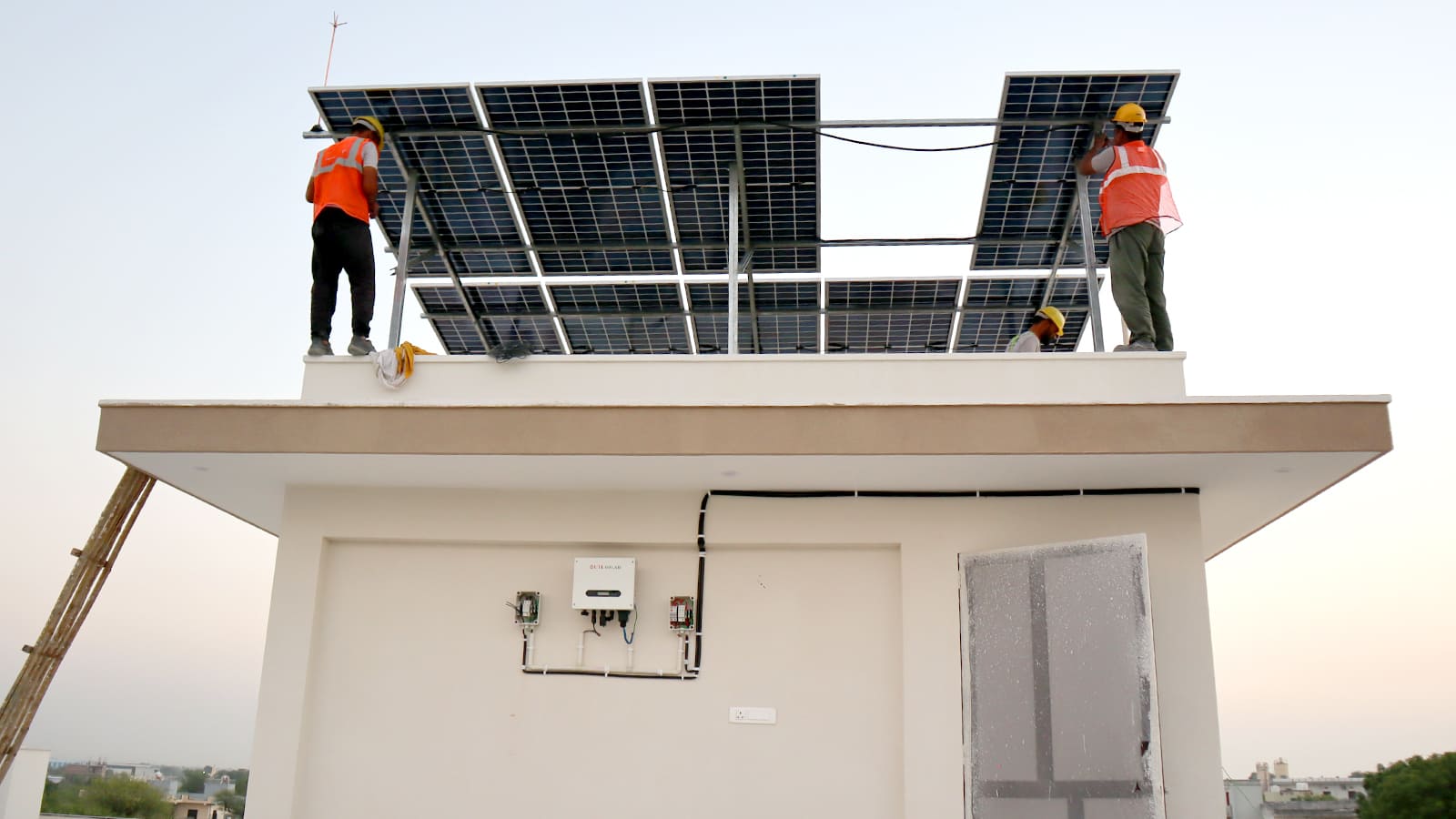
Engineer accountability in practice
Six cities, six resident engineering teams, one operating standard.
Nairobi headquarters plus field hubs in Mombasa, Kisumu, Eldoret, Kitui, and Nakuru. Each hub carries a resident engineering team and a regional spare-parts depot. Every installed system therefore sits within a same-day drive of an engineer who has worked on it before.
No handoffs
What "no subcontractors" actually means.
We do not subcontract the install, the wiring, or the service visits. The engineer who scopes your site is on the crew that installs your system. The crew that installs your system is the team that returns for the five-year service cycle.
This is not because subcontracting is impossible to manage. It is because for a five-year service commitment to mean anything, the people on the hook for the outcome have to be the people in the design and install record. The accountability stays in one team, not split across three.
For Commercial Plus deployments where specialised civil works or grid interconnection requires a regulated partner (utility engagement, structural civils on a 1 MWp ground-mount), those partners work to a Precifarm design and a Precifarm-led commissioning. The accountability never leaves us.
From quote to commissioning
Four steps, every project.
- 1
Site audit
We dispatch an engineer to evaluate your roof structure, analyse your exact load requirements, and map your daily energy routine.
- 2
Custom engineering
We size your solar array, lithium storage, and inverter capacity precisely. You receive a written design and bill of quantities before any commitment.
- 3
Professional installation
Deployed by EPRA-licensed crews with all hardware on-site. Residential installs typically complete same-day; commercial sites are sequenced to avoid operational disruption.
- 4
Five-year service
Scheduled preventive maintenance, fault response from your regional depot, warranty management handled by us. The same team across all five years.
Lifelong accountability, in writing.
Every Precifarm install is backed by a five-year service commitment. Tell us about your site and we will reply with a written design within two business days.